Tattoo Styles
There are many styles we enjoy tattooing, as shown below. But what we no longer tattoo is explained by clicking here.
Realistic

As the name suggests, realistic tattoos aim to reproduce an image as realistically as possible. The focus is on detail, and a skilled tattoo artist knows how to work with light and understands perfectly how shadows affect an image.
Realistic tattoos can be created in black and grey or in colour. Images often chosen within realism include portraits of deceased loved ones, celebrities or animals.
The style has developed considerably in recent years. Nowadays, almost any imaginable colour can be tattooed, and the latest machines make it possible to create extremely fine details in tattoos.
Black & Gray

Black and Grey tattoos originated in prisons in the 1970s. Prisoners made their own needles and black ink and secretly tattooed each other. Because they could only create black ink and shades of grey, the Black and Grey style emerged.
In the 1980s, this style became popular with the general public. Black and Grey was then adopted by tattoo studios and gradually evolved into the style we now know as Black and Grey.
Black and Grey uses black ink and many shades of grey. The tattoos usually contain a lot of detail and are often combined with realism.
Neo-Traditional

Neo Traditional is a modern tattoo style that originated from American Traditional. The styles have many similarities, such as clear linework, bright colours and tattoos featuring easily recognisable images. However, Neo Traditional goes a step further than American Traditional. The tattoos generally contain more colour tones and have smoother colour gradients. In addition, more detail is added to the tattoos, making the images appear less flat.
Neo Traditional emerged because tattoo artists nowadays have an enormous colour palette available to them, whereas in the past they could only work with a few basic colours.
Trash Polka

Trash Polka combines realism with surrealism. Trash Polka tattoos also feature lettering in different fonts, along with other layers and images (Trash). Commonly used images include birds, skulls, clocks, compasses and abstract shapes.
The style is easily recognisable by its use of colour. The tattoos are in black and grey with bright red accents. Because a Trash Polka tattoo contains many different images, letters and elements, it often resembles a collage.
Trash Polka is popular among tattoo enthusiasts because of its unusual combination of realism and chaos. Everything is brought together into one cohesive design in a large tattoo.
New School

New School originated in the 1970s when tattoo artists began experimenting with different perspectives and brighter colours. Tattoo artists adopted characteristics of graffiti and drew inspiration from video games and Disney films. Bold outlines, distorted perspectives and the use of bright colours form the basis of New School.
Because of its Disney-like drawing style, New School is also described as a cartoon style. Many New School tattoos feature elements or characters from video games, comic books, anime or manga.
Geometric

Geometric tattoos are tattoos made up of geometric shapes and patterns, such as circles, triangles, squares or straight lines. Symmetry is very important in this style.
A new trend is the combination of geometry and realism. In this approach, an image is divided into two halves, with the left side depicted realistically and the right side depicted geometrically. A well-known movement within geometric tattooing is ‘sacred geometry’. This involves using shapes and patterns that are also found in nature, with each shape having its own symbolic meaning.
Maori / Polynesian

The best-known tattooed tribes are the Polynesians, Māori and Hawaiians, each with their own tradition within tribal tattooing. These tribes used tattoos to express various aspects of their culture, such as values and beliefs, spirituality, victories in war, identity or social status. The explorer Captain Cook introduced tribal tattoos to the Western world, and today tribal tattoos have become an integral part of the tattoo scene.
Tribal tattoos feature thick black lines that flow across the body in abstract shapes. The tattoos consist of various solid areas and symbols. The balance between ink and untouched skin is important in these tattoos.
By basing your tattoo on designs from indigenous tribes, you can give your tattoo a spiritual meaning.
Japanese

Japanese tattoos, also known as Irezumi, have a rich history. Japanese tattooing began as a form of folk art but was later used to ‘brand’ criminals. Tattoos were also mainly worn by members of the Yakuza, the Japanese mafia, which is why tattoos are still associated with crime in Japan.
Japanese tattoos generally feature flat images, with extensive use of red, green, gold and brown colours.
Japanese tattoos carry a great deal of symbolism and tell a story about the wearer. Many themes from Japanese mythology are used, such as koi carp, dragons, demons and warriors. Each image has its own meaning.
Watercolour

Watercolour tattoo is a new tattoo style inspired by watercolour artworks. Characteristics of watercolour tattoos include paint drips, splashes and flowing lines, where the ink does not stay within the boundaries of the image. In general, hardly any black ink is used. Bright colours form the basis of the image, with the colours sometimes diluted to create a watercolour effect. Common images in watercolour tattoos include flowers, animals and famous artworks.
Dotwork
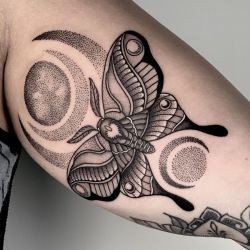
Dotwork is thousands of years old and was originally used in religious art. Dotwork has become incredibly popular again in recent years. The style can be used for all kinds of designs, from geometric patterns to portraits.
Dotwork is characterised by the use of few or no lines. The tattoo consists of small, individual dots that together form one complete image. By placing dots closer together or further apart, the tattoo artist can create shading and darker or lighter areas.
Old School

Old School tattoos, also known as American Traditional tattoos, were especially popular among American sailors.
They travelled the world, getting tattoos to commemorate the adventures they had on their voyages. A swallow tattoo, for example, traditionally signified that the wearer had sailed 5,000 miles.
Old School tattoos are known for their bold, clearly defined designs and thick, striking outlines. The colours most commonly used are green, red, yellow, blue and black. Popular designs include roses, anchors, birds, ships, tough-looking men and beautiful women. These tattoos also often feature a ribbon or banner with lettering.
Rest
And of course, there are so many more tattoo styles to explore.
For example, we can combine different styles to create something completely new. The possibilities are almost endless. Feel free to ask us about this, but you can find out which tattoos we no longer do by clicking here.